Most GCSE tutoring decisions get made twice, badly. Once in the panic before summer, when a “bootcamp” sounds like the fix for a weak set of mocks. And once again in October, when the summer course has ended, the syllabus has moved on, and nothing structural has changed. A full-year GCSE bootcamp exists to close exactly that gap — but most parents have never heard the term, let alone compared it properly against the alternatives.
Contents
- The Decision Parents Actually Face
- Three Formats, Compared Properly
- What the Evidence Actually Says
- What a Full-Year Bootcamp Looks Like in Practice
- How to Choose the Right Format for Your Child
- Mistakes Parents Make When Choosing
- FAQ
The Decision Parents Actually Face
The gap between those two panicked moments is the real problem. A summer bootcamp is a burst of intensity applied to a year-long subject. A weekly 1-to-1 tutor is continuous but slow, and expensive enough that most families cap it at one hour a week — not enough to move a grade on its own. What’s missing for a lot of Year 10 and Year 11 students is something structured enough to actually cover the syllabus, but sustained enough to do it before exam season, not during it.
That’s the case for a full-year bootcamp as its own category — not a bigger summer course, and not a replacement for 1-to-1, but a third option built around the shape of the academic year itself. This guide compares all three honestly, including where each one is the wrong call.
Three Formats, Compared Properly
Summer bootcamps
A concentrated block of sessions — typically one to six weeks — run over the summer holidays before Year 10 or Year 11 starts. Strong for rebuilding confidence after a weak set of mocks, revisiting a specific unit before it’s examined, or giving a child who’s fallen behind a running start into the new school year.
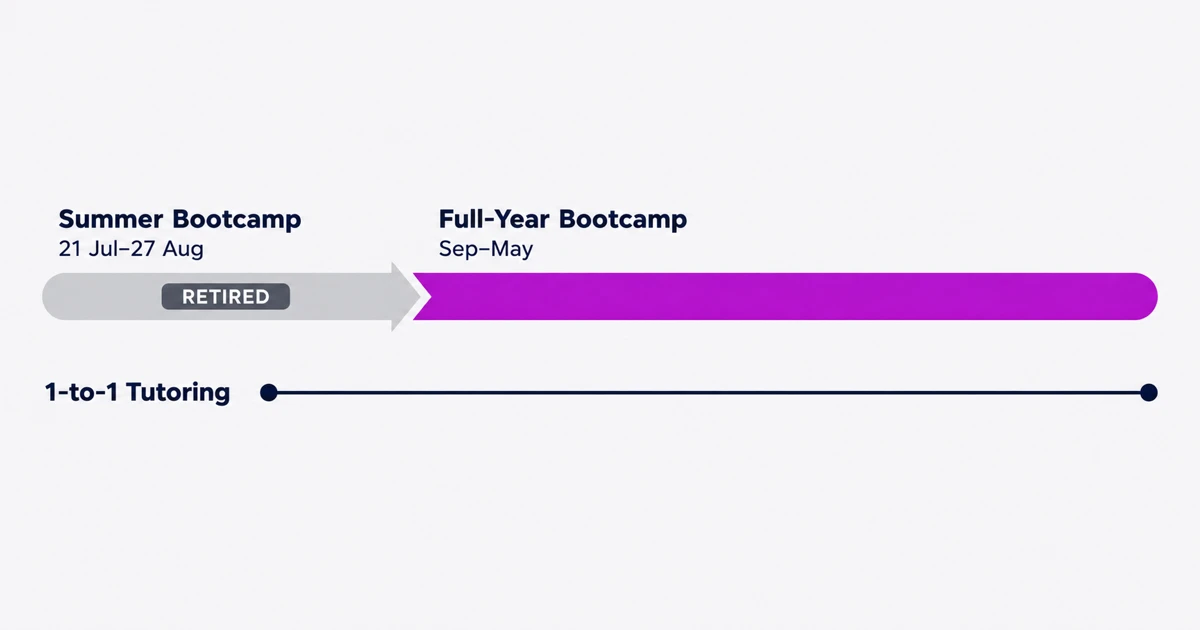
The limitation isn’t the format, it’s the timing. A summer bootcamp happens before nine more months of new content. Whatever ground it covers competes with everything the school then teaches between September and the exam. It’s a strong opening move, not a season-long strategy — which is exactly what we found running one ourselves. Ariston’s own summer bootcamp ran 21 July to 27 August; the format worked well for what it was, but it couldn’t do anything about the nine months of new syllabus that followed it. That’s the direct reason it’s since been retired in favour of the full-year programme below — not a bigger summer course, but a different shape of programme entirely.
1-to-1 tutoring
Fully adaptive to one child’s pace and gaps — the tutor can spend the whole session on the one topic that isn’t landing. Whether that’s the right call for your child specifically comes down to depth versus breadth of the gap, which we’ve broken down in detail in how to choose a GCSE maths tutor; the short version is that a narrow, specific weakness suits 1-to-1, while gaps spread across the whole syllabus tend to suit structured group teaching.
What’s specific to the full-year question is what happens over nine months rather than a single term. Most families run 1-to-1 at one session a week, which — across 36+ weeks of an academic year — rarely reaches the total teaching hours a structured group programme covers in the same period. And a single tutor working alone doesn’t automatically guarantee syllabus coverage: without a fixed curriculum plan behind it, 1-to-1 can drift toward whatever the most recent homework or mock highlighted, rather than working through the specification in order.
Full-year bootcamps
A structured, small-group programme that runs across the academic year rather than a single holiday — Ariston’s GCSE Full-Year Bootcamp is built this way: live online sessions, groups capped at six students, running from September through to just before study leave, with the syllabus mapped out session-by-session in advance rather than reacting week to week.
The trade-off is the mirror image of 1-to-1: less moment-to-moment personalisation, in exchange for guaranteed coverage, a fixed weekly rhythm the whole family can plan around, and a lower cost per teaching hour than most 1-to-1 arrangements at equivalent volume. It suits a child who’s roughly on track but needs consistent structure and accountability more than bespoke, topic-by-topic intervention.
What the Evidence Actually Says
None of this needs to be taken on faith — the Education Endowment Foundation (EEF), the body UK schools use to evaluate which interventions are worth the budget, has independently reviewed both formats.
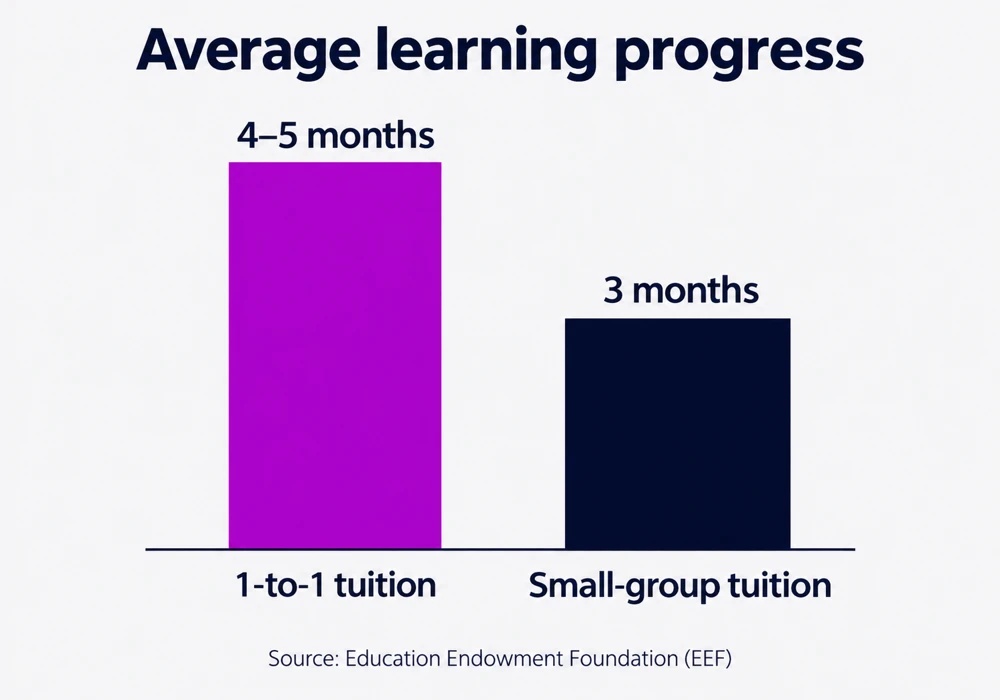
Their Teaching and Learning Toolkit rates one-to-one tuition as adding an average of 4–5 months’ additional progress, based on 123 studies — a moderate-strength evidence base. Their small group tuition review — covering groups of two to five pupils, close to (though slightly smaller than) a full-year bootcamp’s group size — found an average of 3 months’ additional progress after just 12 sessions, describing small-group teaching as “nearly as effective as individual tuition, but at a lower cost.”
Two things follow from that. First, the outright best individual-progress numbers do sit with 1-to-1 — if budget and time genuinely aren’t a constraint, and the goal is deep, narrow remediation, that’s a fair reason to choose it. Second, the gap is a lot smaller than the price difference usually implies. Twelve small-group sessions closing to within a month of 1-to-1’s average impact is the actual argument for a structured group format: most of the benefit, delivered to more students, for less per hour.
Neither number, on its own, tells you what to do about a whole academic year rather than a 12-session block — that’s a question of structure and consistency, which the next section covers.
What a Full-Year Bootcamp Looks Like in Practice
Concretely, on Ariston’s programme: Year 10 groups run holiday-free across the school year, working through Maths and Combined or Triple Science in sequence rather than in response to whatever the school covered that week. Year 11 groups run on Saturdays and are structured to finish the specification before study leave begins, ahead of exams starting 10 May 2027 — so the final weeks before the exam are for practice and gap-filling, not still-new content.
Groups are capped at six students — above the EEF’s small-group definition of two to five, but still small enough that a tutor tracks each student’s specific gaps within the shared curriculum, rather than teaching to the middle of a much larger class. Sessions run live online, at £300 a term per subject, which — across a full year — tends to land below the total cost of weekly 1-to-1 covering the same number of teaching hours, for families where that comparison matters.
What this format doesn’t do is replace a tutor’s ability to spend forty-five minutes on one child’s one misunderstanding. It’s the right call when the priority is coverage, consistency and a fixed weekly commitment — not when a child needs concentrated, adaptive support on a narrow set of gaps.
How to Choose the Right Format for Your Child
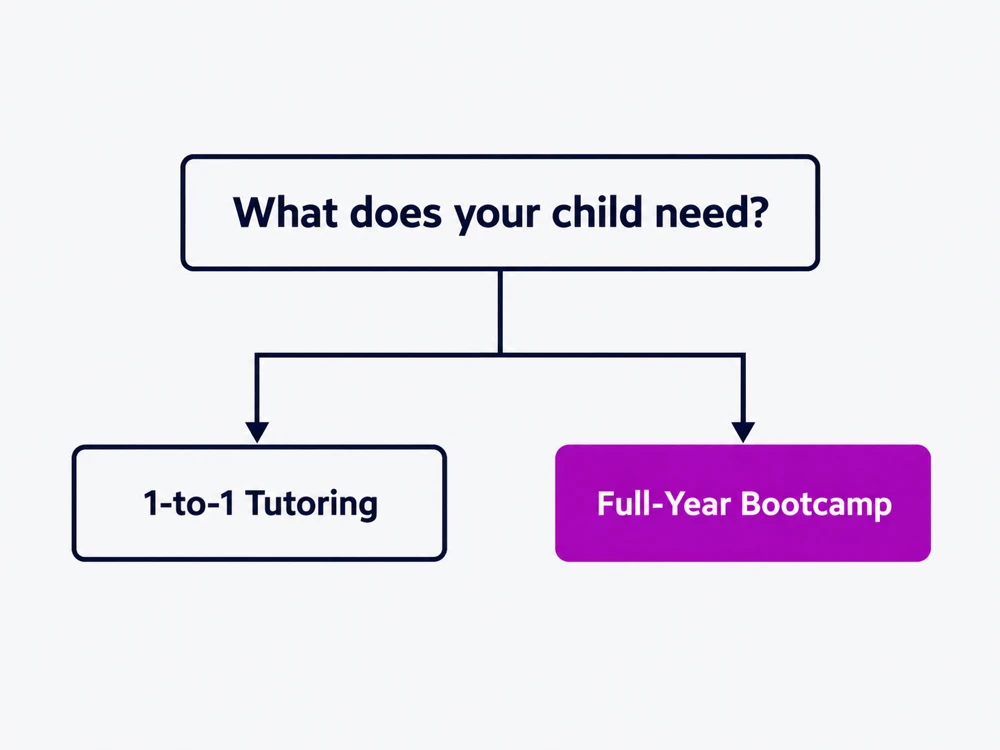
A few honest questions, in order:
- Is the gap narrow or broad? This is the single biggest factor, and it deserves its own answer rather than a quick bullet — see how to choose a GCSE maths tutor for the full breakdown. Short version: a specific, nameable weakness suits 1-to-1; gaps spread across the whole syllabus suit a structured group.
- Is the problem timing or content? If your child understands the material but panics under exam conditions close to the date, a shorter, intensive block closer to the exam addresses that more directly than a full-year commitment — worth checking what a provider currently offers, since not every format runs year-round.
- How much can the family realistically sustain weekly, for nine months? A full-year programme only works if the weekly slot survives half-term, mock season and the inevitable weeks nobody feels like it. If that’s not realistic, a shorter, higher-intensity block may fit the family’s actual capacity better, even if the format is theoretically less efficient per hour.
- Does your child work better with peers or alone? Some students are demonstrably more engaged in a small group — seeing a peer struggle with the same question and then get it normalises difficulty rather than making it feel personal. Others focus better with undivided attention and no audience. This is a genuine personality factor, not a budget one, and it’s worth being honest about which describes your child.
Mistakes Parents Make When Choosing
Booking a summer bootcamp as if it’s a full solution. It’s an excellent opening move — confidence, a running start, closing a specific gap before term starts — but treating five or six weeks in the summer holidays as equivalent to nine months of consistent support sets an unrealistic expectation for what happens from September onward.
Assuming 1-to-1 is automatically “more” because it’s more expensive. Per the EEF data above, the actual progress gap between formats is narrower than the price gap. More expensive isn’t the same as more effective for every student — it depends on whether the gap is narrow (1-to-1’s strength) or broad (structured group’s strength).
Choosing a format based on Year 10 needs and keeping it unchanged through Year 11. The right format can genuinely change as exams approach — a child who did well with a full-year structured programme through Year 10 and the start of Year 11 may benefit from adding a short, targeted 1-to-1 block in the final term to close specific remaining gaps. The formats aren’t mutually exclusive across the two years.
Not checking whether the syllabus is actually mapped out in advance. Whether it’s 1-to-1 or group tuition, ask directly: is there a plan for what gets covered and when, mapped against the exam date? Reactive tutoring — however well-intentioned — is not the same as a programme built around finishing the specification on time.
FAQ
Is a full-year GCSE bootcamp better than 1-to-1 tutoring?
Neither is universally better — they suit different problems. EEF data shows 1-to-1 tuition delivers slightly higher average individual progress (4–5 months vs. 3 months for small-group tuition), but a full-year structured programme guarantees syllabus coverage across the whole year at a lower cost per teaching hour, which matters most for a child who needs consistency rather than narrow, adaptive support.
How many students are in a full-year GCSE bootcamp group?
It varies by provider. Ariston’s programme caps groups at six students; the EEF’s own definition of “small group tuition” covers groups of two to five. Smaller generally means more individual attention within the group — worth checking directly with any provider you’re considering.
When should we start a full-year GCSE bootcamp — does it have to be September?
Starting at the beginning of the academic year gives the most complete syllabus coverage, since the programme is built around finishing the specification before study leave. Most full-year programmes, including Ariston’s, do allow later enrolment with catch-up resources for the sessions already missed — but earlier is meaningfully better for full coverage.
Can you combine a full-year bootcamp with 1-to-1 tutoring?
Yes, and it’s a reasonable strategy for a child who needs both: the group programme for broad, consistent syllabus coverage, plus a shorter block of 1-to-1 in the run-up to exams for narrow, specific gaps that the group format doesn’t have time to address individually.
Does a full-year bootcamp work for both Foundation and Higher tier?
It should, provided the programme differentiates by tier rather than teaching one syllabus to everyone. Check this specifically — Ariston’s programme, for example, separates Maths into Foundation and Higher tracks within the same structure.
Is online tutoring as effective as in-person for a full-year programme?
The EEF’s toolkit doesn’t treat delivery mode (online vs. in-person) as a separate major factor in its headline progress figures — the format (1-to-1, small group) and consistency matter more than whether it happens on a screen or in a room. For a full-year commitment specifically, online delivery removes travel time from the weekly commitment, which is one of the more common reasons families drop out of long-running programmes.
Ready to See If a Full-Year Format Fits Your Child?
If the honest answer to the questions above points toward structure and consistency over narrow, adaptive support, take a closer look at the GCSE Full-Year Bootcamp — live online, small groups capped at six, Maths and Combined or Triple Science, running the full academic year for Years 10 and 11.
For a broader look at revision options beyond the full-year format, see our GCSE revision hub, or read more about subject-specific support on our maths tutoring page.