
Quick answer: Check qualifications and DBS — but don’t stop there. The single biggest predictor of tutoring success is personality and learning-style fit. Most parents skip this step entirely, then wonder why a perfectly qualified tutor isn’t moving the needle.
Table of Contents
- Start with what your child actually needs
- How you find candidates changes everything
- The matching factor: what most parents overlook
- What to verify before the first lesson
- The trial lesson: what to watch for
- Red flags that tell you this tutor isn’t right
- Online vs in-person: which is better for your child?
- FAQ
Here’s an uncomfortable truth from the tutoring world: most families who come to us have already tried a tutor.
They found someone with the right grades, the right subject, sometimes even the right exam board — and it still didn’t work. The child disengaged. Progress stalled. After six sessions and £300, the parent is back at square one, wondering what went wrong.
The answer, almost every time, is the same: the match was wrong.
Knowing how to choose a private tutor in the UK is not just a qualifications exercise. It’s a pairing exercise. Get it right and you’ll see improvement within weeks. Get it wrong and you’ll spend money watching your child go through the motions of being tutored without actually being helped.
This guide will show you exactly how to choose a private tutor who actually moves the needle.
Step 1: Start With What Your Child Actually Needs
The most important step in knowing how to choose a private tutor is to answer these four questions before you look at a single profile:
1. What specific problem are we solving?
“My child is struggling with maths” is too vague. “My child is in Year 10, sitting Edexcel GCSE Maths, and consistently drops marks on algebra and ratio problems” is something a tutor can work with immediately.
2. What is my child’s learning style?
Some children thrive with a tutor who is encouraging and patient, building confidence slowly. Others respond better to a direct, exam-focused approach with worked examples and timed practice. These are not interchangeable — a mismatch here is one of the most common reasons tutoring fails.
3. What is my child’s emotional state around this subject?
A child who has developed maths anxiety needs a different kind of tutor than a child who is bored and under-challenged. The former needs someone who can rebuild confidence; the latter needs someone who can extend and stretch them.
4. What is the specific exam board and syllabus?
AQA, Edexcel, OCR, WJEC, and Cambridge IGCSE all differ in style, question format, and what they reward. A brilliant A-level Chemistry teacher who only knows Edexcel is not the right fit for your child’s OCR exam.
Step 2: How You Find Candidates Changes Everything
There are broadly two ways to find a tutor in the UK:

Tutor marketplaces (Superprof, Tutorful, MyTutor, First Tutors) list tutor profiles that you browse and book directly. You handle the vetting, the matching, and the trial-lesson decision yourself. The advantage is speed and price — marketplaces are generally cheaper. The disadvantage is that the matching work falls entirely on you, usually with limited information and no independent vetting.
Tutoring agencies vet tutors before they’re on the platform — checking qualifications, references, DBS certificates, and conducting interviews — how we vet and select tutors. They then match based on your child’s specific needs. You get fewer choices, but each one has already been qualified against a standard.
Neither is universally better. Marketplaces work well when you have a clear, simple need (e.g., weekly maths support for a confident Year 9 student). Agencies tend to justify their fee when the need is more specific or the stakes are higher — GCSE year, a child who has struggled before, or when personality fit is going to be critical.
The Matching Factor: What Most Parents Overlook
This is the section most guides skip. It’s also the most important.
Qualifications tell you a tutor can teach the subject. The match tells you whether they will work for your child.
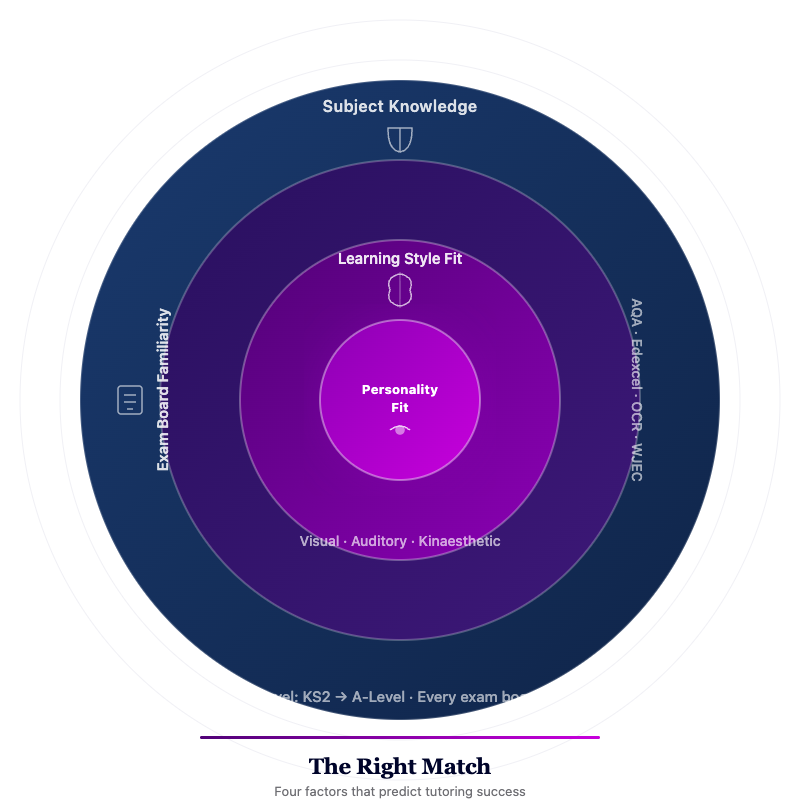
A strong match has four components:
| Component | What to look for |
|---|---|
| Subject knowledge | Degree-level or equivalent in the subject; relevant teaching experience |
| Exam board familiarity | Has taught this specific board at this level before |
| Learning style fit | Teaching approach matches how your child processes information |
| Personality fit | Your child feels comfortable enough to say “I don’t understand” |
That last one is more important than it sounds. A child who is too intimidated by their tutor to admit confusion will not progress — they’ll nod along, do surface-level work, and improve only marginally. The best tutoring relationships are ones where the child feels safe enough to be honestly stuck.
When you’re evaluating tutors, ask directly: “How would you approach a student who has developed anxiety around this subject?” The answer will tell you more than their CV.
What to Verify Before the First Lesson
Don’t skip these, regardless of how the tutor was recommended:
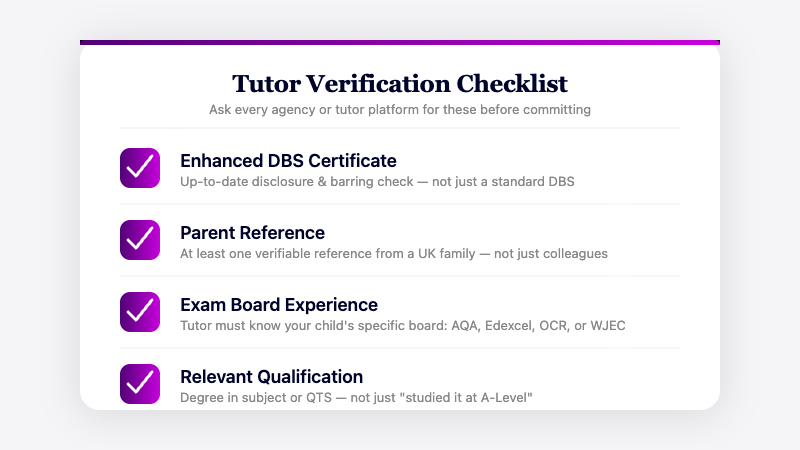
Enhanced DBS Certificate — not a basic check, an enhanced one. Ask to see it, not just be told it exists. It should be recent (within the last two years, ideally) and clean. Private tutors are not automatically required to have one in the UK — see NSPCC guidance on safe tutor hiring — so platforms that don’t require it are passing that responsibility to you.
References from parents — most tutors can provide academic or employer references. Ask specifically for a reference from a parent whose child they’ve tutored. A tutor who can’t provide one after a year or more of tutoring is a yellow flag.
Exam board experience — ask: “Have you tutored students on [specific board] at [level]? What do students typically find hardest on this paper, and how do you address it?” A tutor with genuine experience will answer confidently and specifically.
Relevant qualification — a degree in the subject is the standard bar for secondary students. For primary tutors, qualified teacher status or specific SEN training is worth asking about if your child has additional needs.
The Trial Lesson: What to Watch For
Once you know how to choose a private tutor on paper, the trial lesson is where you confirm it in person. Always insist on one before committing to a block of sessions. Here’s what to observe:
At the start of the lesson: Does the tutor ask your child questions about how they learn, what they find difficult, or what previous teachers have done that worked? Or do they just start teaching? A good tutor diagnoses before they prescribe.
During the lesson: Is your child nodding along, or are they genuinely engaged and asking questions? Are they relaxed enough to say they don’t understand?
At the end: Does the tutor give you specific, actionable feedback — “She’s solid on equations but loses marks on showing working, so we’ll focus on exam technique next” — or do they give you a vague summary?
After the lesson, ask your child one question: “Did you like them?” Not “do you think they’ll help?” — children aren’t always the best judges of pedagogical quality. But genuine rapport matters, and your child will tell you if it’s simply not there.
Red Flags That Tell You This Tutor Isn’t Right
Walk away if:
- They can’t show you an Enhanced DBS certificate. No exceptions.
- They push you to commit to 10+ sessions before a trial. Good tutors are confident enough in their work to let you trial first.
- They can’t explain their approach to your child’s specific difficulty. “I’ll go through the topics with them” is not a plan.
- They’ve never taught your child’s exam board at this level. Exam technique is board-specific — it’s a real skill gap.
- Your child doesn’t relax by the end of the trial lesson. Chemistry matters. If it’s not there after one session, it rarely arrives.
- They have no parent references. After any meaningful period of tutoring, a good tutor should have at least one parent who’ll speak about results.
Online vs In-Person: Which Is Better for Your Child?
The evidence no longer strongly favours either. For most secondary students (GCSE and above), online tutoring works just as well as in-person — often better, because you have access to a wider pool of tutors and scheduling is more flexible.
In-person tends to have an edge for:
- Younger children (primary age) who benefit from physical presence and hands-on materials
- Students with attention or focus difficulties who need closer supervision
- Children who have developed technology-related distraction habits
Online tends to have an edge for:
- Busy families where travel time is a barrier to consistency
- Students who need a highly specific tutor (rare subject, specific exam board) who may not live locally
- Students who are already comfortable with video-based learning
Whichever format you choose, consistency is more predictive of results than format. A child who sees their tutor reliably every week for three months will outperform one who sees a marginally “better” tutor irregularly.
FAQ: How to Choose a Private Tutor
How much does a private tutor cost in the UK?
Typical rates in 2026 range from £30–45/hour for online GCSE-level tutoring, to £50–80/hour for specialist in-person tutors or A-level preparation in London. Tutoring agencies typically charge a premium over direct-hire freelancers — the tradeoff is vetting, matching support, and a managed replacement if the first tutor isn’t right.
How often should my child see their tutor?
Once a week is the minimum for meaningful progress. Twice weekly in the run-up to exams (6–10 weeks out) tends to produce the best results. Irregular sessions — every two or three weeks — rarely build enough momentum to overcome learning gaps.
How quickly should I see results from private tutoring?
With a well-matched tutor addressing a specific gap, most parents notice a change in confidence within 4–6 sessions. Measurable grade improvement takes longer — typically a full term of consistent work. If nothing has changed after 10 sessions, the match should be reviewed, not the frequency.
Do private tutors need to be DBS checked?
Private tutors in the UK are not legally required to have a DBS check — but any reputable tutor working with children should have one, and any reputable agency will require it as standard. Always ask to see the certificate, not just a verbal confirmation.
What’s the difference between a tutoring agency and a tutoring marketplace?
A marketplace lists tutor profiles for you to browse and book directly. An agency vets tutors in advance and actively matches them to your child’s needs. Agencies are typically more expensive but reduce the risk of a poor match and handle replacement if the first tutor doesn’t work out.
The real answer to how to choose a private tutor comes down to one thing above all: the right match. At Ariston Education, every introduction is made on subject knowledge, exam board experience, learning style, and personality fit — not just availability. If you’ve had a bad experience with tutoring before, it’s worth booking a free consultation.